Silicone as a System: What Recoat Cycles Look Like
Review the scope, field conditions, system options, and planning considerations for this commercial roofing topic.
Read More →
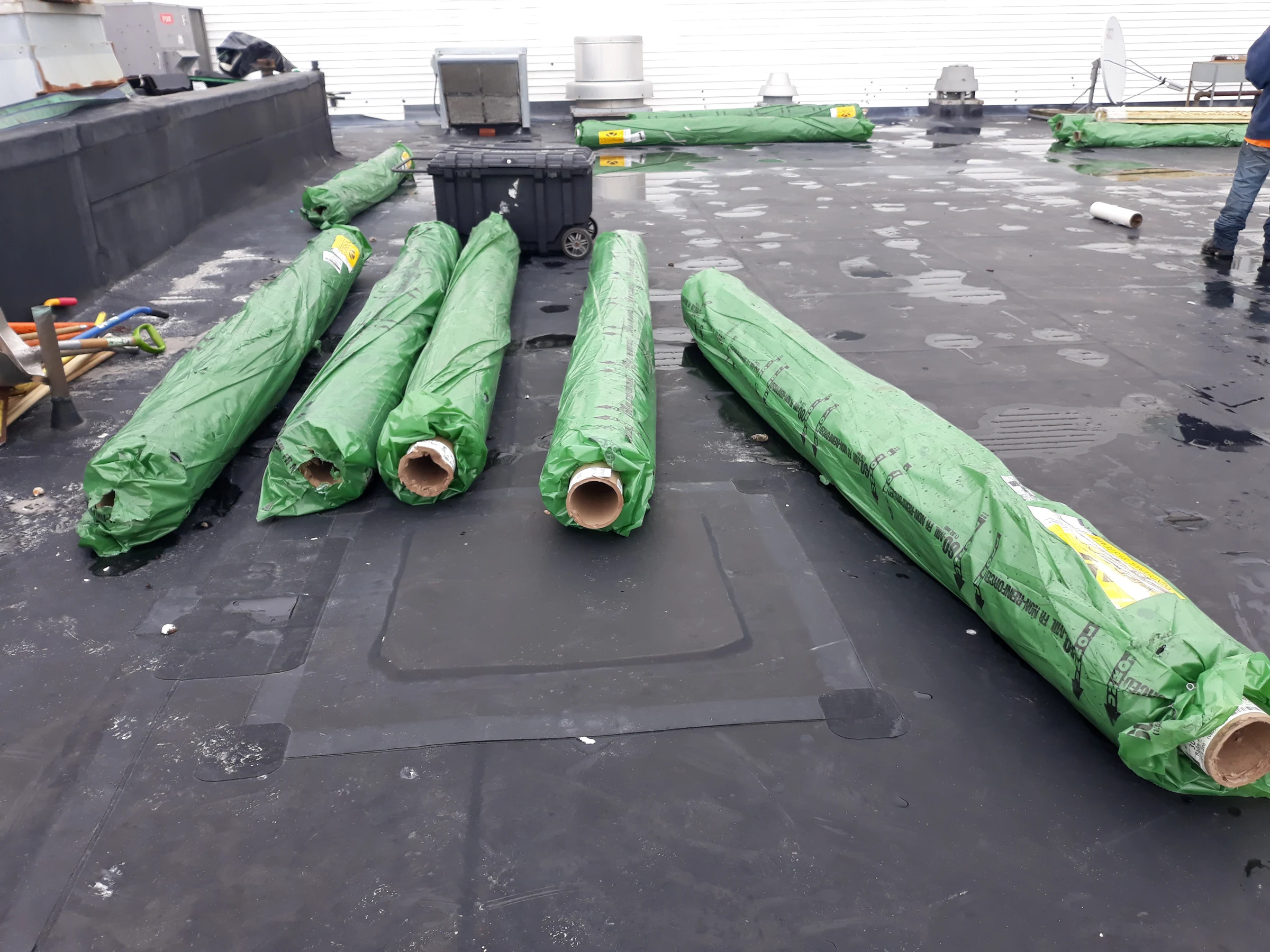
PVC membrane resists oils, greases, and certain chemical exposures better than TPO or EPDM, which makes it the right call on a specific slice of roofs around the region: kitchen exhaust areas, lab exhaust, industrial rooftop equipment, and an unnecessary upgrade on a plain office or retail roof with none of that exposure.
Restaurant and food service rooftop exhaust, grease trap venting, and rooftop equipment tied to food processing or cold storage operations expose the membrane directly to oils and greases that soften and degrade standard TPO membrane over time. PVC's formulation resists that kind of exposure significantly better, which is why it shows up specified around grease exhaust penetrations even on roofs that are otherwise TPO.
Pharmaceutical and lab buildings, Regeneron's manufacturing campus in Rensselaer and lab space tied to SUNY Poly's nanotech research are the kind of facility type where this comes up, sometimes vent process exhaust with chemical content that isn't compatible with a standard membrane, and PVC's chemical resistance profile is the deciding factor in those specific zones.
Some proposals push PVC across an entire roof deck when the actual chemical exposure is limited to one exhaust zone or a handful of penetrations. That's not always wrong, a hospital or surgery center roof might reasonably go full PVC given the density of exhaust and mechanical penetrations, but on a roof where exposure is limited to a couple of rooftop units, a targeted PVC patch or boot at the specific penetration accomplishes the same protection without paying PVC pricing across the whole field.
We look at where the actual chemical or grease exposure is concentrated before recommending full-roof PVC versus a hybrid approach with a different field membrane and PVC detailing only where it's needed.
A strip retail building with a single restaurant tenant is a common example of where this distinction matters. The grease exhaust from that one tenant's kitchen doesn't justify pricing the entire roof in PVC when the other units have no comparable exposure, and a hybrid spec with a TPO field and PVC detailing around the restaurant's exhaust penetration solves the actual problem at a lower total cost.
PVC seams heat-weld similarly to TPO, fusing the sheets together rather than relying on adhesive or tape. Weld quality still depends entirely on temperature control, weld speed, and the welder's technique; a poorly controlled weld can look bonded on the surface while not achieving a full weld through the seam thickness.
We test welded seams with a probe during installation, not only at final inspection, because a cold weld that fails a probe test early is far cheaper to fix mid-installation than after the crew has moved on and the roof is buttoned up. This applies to any of our PVC roofing installs, not only the chemical-exposure zones.
A bid that specifies PVC across the whole roof without identifying where the actual chemical or grease exposure is concentrated may be padding the estimate rather than solving a real problem.
On a PVC roofing bid we check for:
Buildings with dense rooftop exhaust and mechanical penetrations, hospital surgery centers, lab space, food processing facilities, tend to have decks with more existing penetrations and patch history than a simple office roof, which affects whether recover or tear-off makes more sense. A recover over a deck with a lot of prior penetration repairs sometimes just carries old problems forward under new membrane.
We inspect penetration density and prior repair history closely on these building types before recommending recover, since the exhaust and mechanical footprint on a lab or hospital roof tends to be denser and more failure-prone than on a typical commercial roof.
Facilities tied to cold storage or food processing operations add another wrinkle, since refrigeration equipment and exhaust stacks tend to be added incrementally as operations expand, leaving a deck with penetrations from several different eras of construction. We map that penetration history against the current roof plan before scoping a recover, rather than assuming the original roof drawings still reflect what's actually up there.
No. Its real advantage is chemical and grease resistance. On a roof without that exposure, TPO or EPDM performs comparably at a lower cost.
Not always. Targeted PVC detailing at specific exhaust or penetration zones can provide the needed protection without full-roof PVC pricing, depending on how concentrated the exposure is.
Both are heat-welded, but the sheet chemistry differs. Weld quality on either depends on temperature control and technique, not the membrane type itself.
Yes. Oils and greases soften and degrade standard membrane formulations faster than they affect PVC, which is why kitchen exhaust zones are a common place to see PVC specified even on an otherwise TPO roof.
Facilities with dense chemical or grease exposure across most of the roof, some food processing and lab buildings, are where full-roof PVC makes practical sense rather than targeted application.