R-Panel Metal Roofing for Rail and Industrial Buildings
Review the scope, field conditions, system options, and planning considerations for this commercial roofing topic.
Read More →
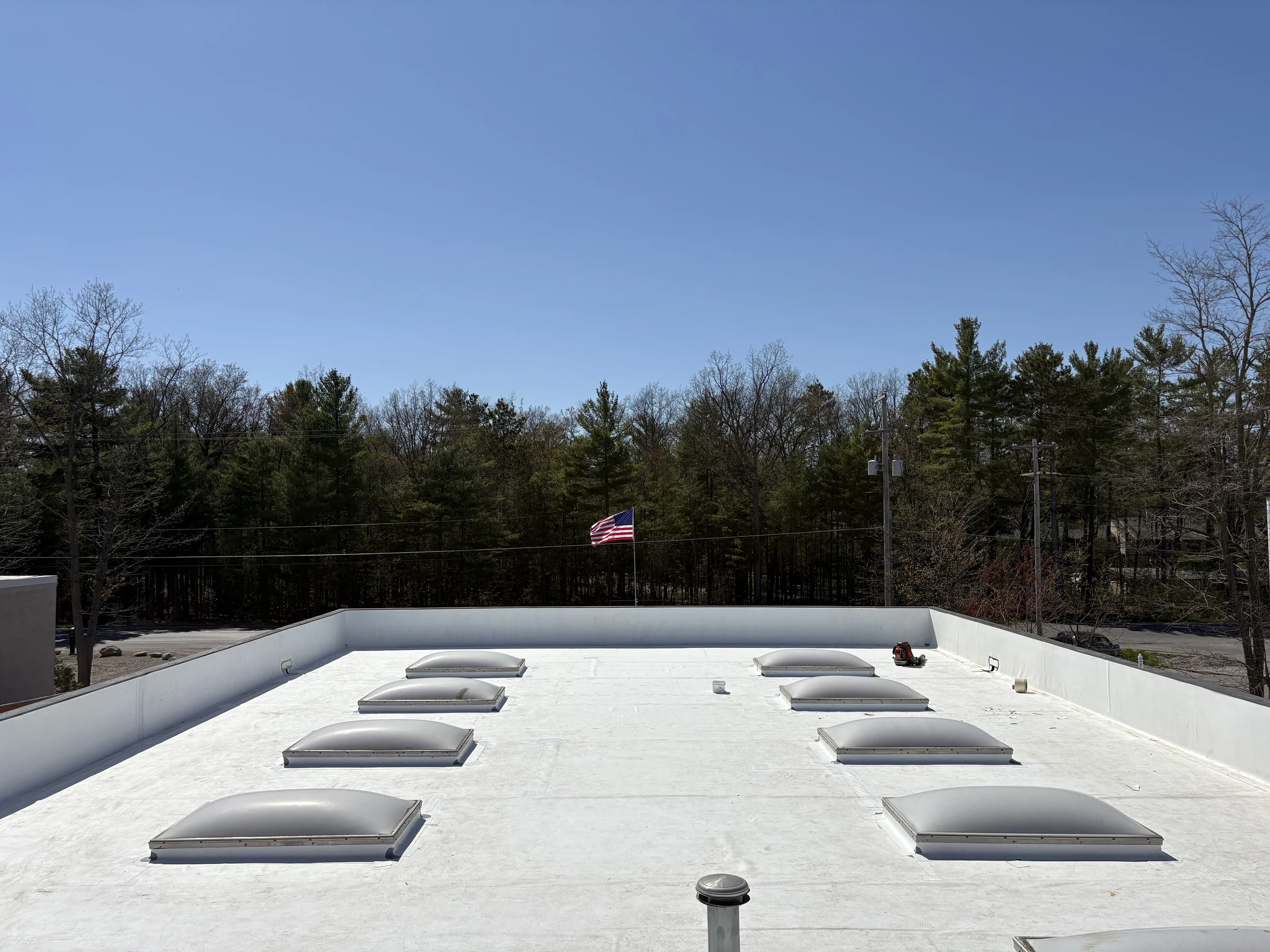
PVC gets specified less often than TPO or EPDM across the Capital Region, but it's the right membrane on a specific slice of buildings: rooftops with grease exhaust, chemical exposure, or process equipment where a standard single-ply membrane would break down faster than expected. Knowing when PVC actually earns its higher price is the first question, not the last one.
Food processing and cold storage buildings, which show up in our industries list for a reason, are a common PVC candidate. Rooftop grease exhaust from processing equipment degrades TPO and EPDM membranes over time in ways PVC resists better because of its chemical composition.
Pharmaceutical and lab buildings tied to the Regeneron campus in Rensselaer and support buildings around the SUNY Poly NanoTech complex sometimes have rooftop exhaust or process venting that carries solvents or other compounds a standard membrane isn't built to handle. On those roofs, PVC's resistance to oils and chemicals is worth the added cost.
We also look at PVC on roofs near heavy rooftop mechanical concentrations, where equipment maintenance traffic and occasional fuel or oil spills during service calls put real wear on the membrane surface over the roof's life.
PVC costs more than TPO per square foot, which means a contractor padding a bid has more room to hide a downgrade inside a number that already looks expensive. A proposal that just says "PVC roofing system" without specifying reinforced versus non-reinforced sheet, or membrane thickness, is telling you less than it should for the price you're paying.
Reinforced PVC has a scrim layer for added strength and puncture resistance, which matters on roofs with regular maintenance foot traffic around rooftop equipment. Non-reinforced sheet is thinner and cheaper, and appropriate in fewer situations than some bids suggest.
Compatibility with the existing roof assembly is another spot that gets glossed over. PVC has plasticizers that can react badly with asphalt-based products if the substrate isn't properly separated, which matters on a recover project going over an old built-up or modified bitumen roof. A contractor who doesn't mention a separator sheet on a PVC recover over asphalt-based roofing is skipping a step that protects the membrane's chemistry.
PVC seams are heat-welded, similar to TPO, and the weld quality is what determines whether the seam holds for the life of the roof or opens up early. A proper installer tests welds as they go, using a probe to check for continuous fusion along the seam rather than relying on a visual pass.
On a PVC project we look for and expect the bid to address:
PVC handles the Capital Region's freeze-thaw stretch reasonably well once installed, but installation itself is temperature sensitive in the same way TPO is, since heat welding depends on consistent conditions. We schedule PVC installations around the same seasonal window as other single-ply systems rather than pushing a cold-weather install to meet an arbitrary deadline.
On ponding-prone roofs, which we see plenty of on flat institutional buildings near downtown Albany, PVC holds up to standing water better than some coatings, though tapered insulation to actually move the water off the roof is still the better long-term fix than relying on membrane resistance alone.
On a standard office or retail roof without chemical or grease exposure, PVC's added cost usually doesn't buy you anything TPO wouldn't already deliver. We'll say so directly rather than upselling a system your building doesn't need. The exposure conditions on your specific roof, not a blanket preference, should drive this decision.
We've walked roofs where a previous contractor specified PVC across an entire distribution building because one corner near a single exhaust vent had grease exposure, when a targeted PVC section around that vent paired with TPO across the rest of the field would have delivered the same protection for meaningfully less money. Matching the material to the actual exposure area, rather than the whole roof, is usually the more honest scope.
Usually not, unless there's a specific chemical or grease exposure issue. We'll tell you if TPO is the more sensible choice for your building.
Not without a separator sheet between the PVC and the asphalt substrate, due to plasticizer compatibility issues. Any recover bid should address this directly.
Probe testing along the seam during and after installation checks for continuous fusion. We don't rely on a visual inspection alone for PVC seams.
Yes, its chemical resistance to oils and grease is one of the main reasons it gets specified on food processing and similar buildings.
Reinforced PVC handles foot traffic and equipment maintenance access better than non-reinforced sheet, which is a reason to specify the reinforced version on those roofs.