Stopping Water From Getting Further Inside While the Real Repair Gets Planned
Review the scope, field conditions, system options, and planning considerations for this commercial roofing topic.
Read More →
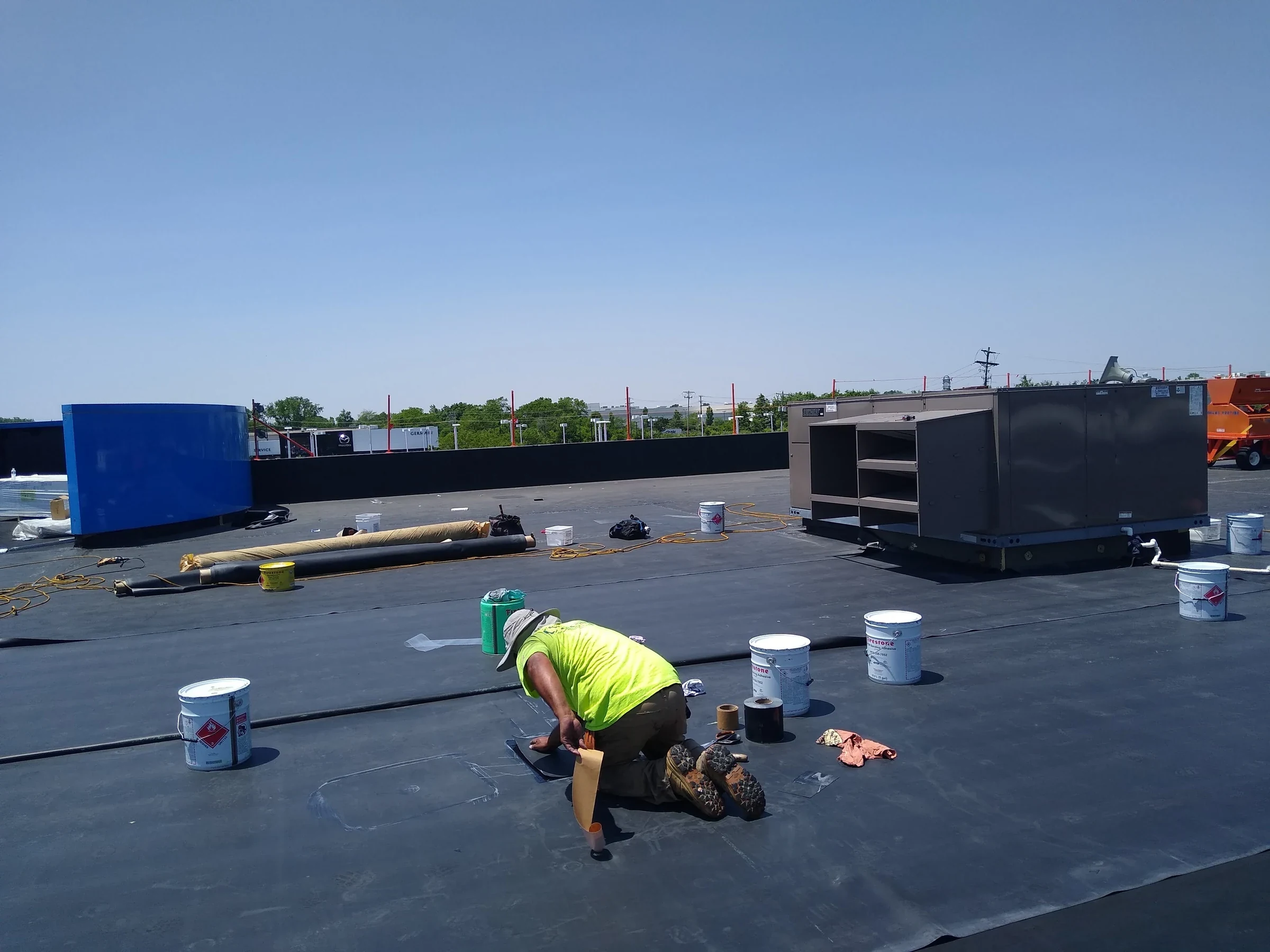
EPDM has been going on Capital Region roofs longer than almost any other single-ply system, and it's still the right call for a lot of the older building stock around Troy, Cohoes, and Watervliet. The catch is that EPDM bids vary more in quality than the material's reputation suggests, mostly around seam work.
Converted mill buildings in Troy and Cohoes, many of them with irregular roof shapes and older parapet details, are common EPDM candidates. Rubber membrane handles the odd angles and multiple roof levels found in these converted industrial structures better than some rigid systems, and it's forgiving of a deck that isn't perfectly flat.
We also see a fair amount of EPDM on smaller commercial buildings around Watervliet, near the Arsenal complex, and on light industrial buildings in Rensselaer and Green Island where budget and simplicity matter more than a highly reflective roof surface.
Ballasted EPDM systems, where the membrane is held down with stone rather than fully adhered or mechanically fastened, still show up on some older warehouse roofs in Rotterdam's industrial park, especially where the original roof was designed around that load.
EPDM traditionally comes in black, and a lot of owners ask whether they should switch to a white or fleece-backed version for energy performance. In this climate, with real winters and a shorter cooling season than roofs further south, the reflectivity argument matters less here than it would in a hotter market. The bigger factor is usually what's compatible with the existing roof assembly and what the building's insulation and ventilation setup already assumes.
Fleece-backed EPDM, which bonds differently than standard sheet, is worth discussing on recover projects where the existing surface isn't perfectly smooth. It's a different product with different attachment requirements, and a bid that lists "EPDM" without specifying which version leaves that decision unclear.
The most common shortcut we find on EPDM roofs installed by other contractors is seam work. EPDM seams use either seam tape with a primer, or an older splice method that depends heavily on proper surface prep and cure time. A rushed splice, or one installed in weather that's too cold for proper adhesion, is a seam that looks fine on installation day and fails within a couple of seasons.
Membrane gauge is the other spot to check. EPDM commonly comes in 45 mil and 60 mil thicknesses, and a proposal that just says "EPDM roofing" without a gauge is leaving room to install the cheaper option without technically misrepresenting anything.
On an EPDM proposal we make sure you can see:
Buildings from the mill and arsenal era around Troy, Cohoes, and Watervliet often have masonry parapets that were never designed with modern flashing details in mind. Water that gets behind an EPDM termination bar at one of these older parapets, then freezes overnight during the Capital Region's freeze-thaw stretch through late winter, works that opening wider every cycle.
We spend more time on parapet and termination detailing on these older buildings than we do on a standard warehouse roof, because that's usually where the leak history is concentrated.
EPDM is one of the more repairable membranes when the base material is still sound. A roof with isolated seam failures or a few flashing problems is often a repair candidate rather than a full tear-off, and we'll tell you when that's the honest recommendation instead of pushing a bigger project than the roof needs.
That said, membrane that's shrinking, hardening, or showing widespread seam separation across the field is past the point where patching makes sense, and we'll walk you through what we're seeing and why a repair wouldn't hold.
Shrinkage is a specific EPDM aging pattern worth watching for on its own, since a membrane that's pulled back from a parapet or curb flashing has usually lost enough elasticity that a single patch at the pulled edge won't hold for long. Once we see shrinkage at multiple details across the same roof, we treat it as an early sign the membrane is approaching the end of its service life rather than a series of unrelated small problems.
For a lot of the older, irregularly shaped buildings we see in Troy and Cohoes, yes. TPO tends to be the better call on large, simple, flat fields like distribution buildings.
Well-installed EPDM with good seam work regularly outlasts poorly seamed membrane by a wide margin. The installation quality matters more than the material's general reputation.
Often, yes, if the membrane itself is still in reasonable condition. We'll tell you plainly if seam repair is a real fix or just a delay before a bigger problem.
Structural load. Ballast adds significant weight, and older mill and arsenal-era buildings weren't always designed for it. We check the structural assumption before recommending ballast.
Yes. Adhesive and seam tape both need proper temperature to cure correctly, which limits our repair windows through the coldest stretch of winter unless it's an emergency situation.